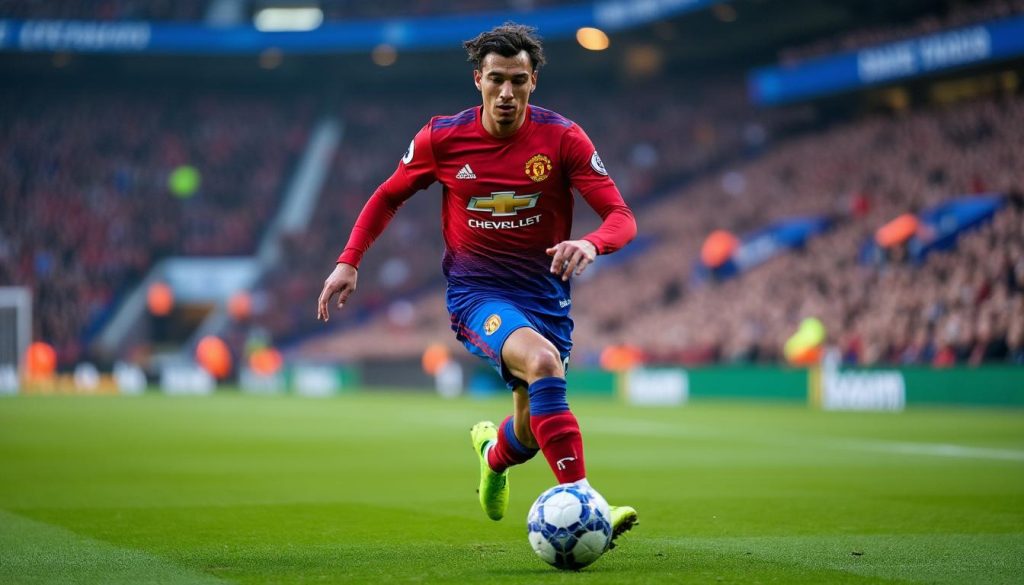
The Premier League in 2025/26 is revealing intriguing shifts in football trends that highlight how possession and chance creation are influencing weekly outcomes. From the noticeable decline in completed passes to a marked resurgence of long-ball tactics, these evolving patterns are reshaping game strategies and team performances across the top flight of English football. Managers are increasingly favoring efficiency and direct play, while attacking prowess is showcased through rising goal-scoring records, especially in aerial duels. This dynamic landscape presents a fascinating tableau of soccer statistics, offering new insights into match analysis and tactical innovation at the highest level.
En bref:
- The Premier League’s average completed passes per match have dropped to 713, the lowest since 2016/17, reflecting a tactical shift away from patient possession.
- Long passes now constitute 11.5% of all passes, with teams like Manchester United and Tottenham Hotspur increasing their direct play significantly.
- Heading effectiveness has soared, with the league on track to set a new record for headed goals, now accounting for over 21% of total goals.
- Stoppage-time goals are at an all-time high, accounting for 13.3% of goals scored, underscoring the increasing drama in late match moments.
- Squad depth and recruitment strategies vary greatly, impacting European qualification races and relegation battles across the league.
How the Decline in Possession Reflects New Premier League Football Trends
The 2025 Premier League season has seen a pronounced decline in the average number of passes completed per match, which now sits at 713, a drop of nearly 9% from peak seasons like 2023/24. This trend signifies a broader shift away from the traditionally possession-heavy style that has defined much of the last decade. Teams are increasingly focused on efficiency rather than volume, resulting in more purposeful distribution and less time spent in buildup phases. For instance, 11 of last season’s 17 consistent Premier League teams have reduced their average passing totals, with sides like Bournemouth, Everton, and Nottingham Forest deliberately bucking the trend by boosting their possession rates.
The data over the last two decades illustrates a steady rise in passes up until recent seasons, but the current pattern indicates a tactical recalibration. Coaches are wary of the risks involved in maintaining prolonged possession against intensive pressing systems, opting instead for quicker ball progression to exploit defensive weaknesses. This approach not only saves energy but often leads to more direct attacking opportunities. Tactical analysts and fans following Premier League weekly outcomes can observe that this is part of the evolving football landscape, where the age of high passes counts is giving way to smarter, faster play.
This reduction in possession and deliberate passing impacts team performance by emphasizing transitional play and counter-attacks, which have proven effective for several clubs this season. By trimming the number of passes, teams reduce the chances of losing possession in dangerous areas, facilitating a sharper counter-attacking game that often results in high-quality chances. This shift encourages managers to rethink their traditional possession-based systems and adapt to a faster, more reactive style that better matches the pace and physicality of modern Premier League football.
| Season | Matches Played | Avg. Completed Passes per Match |
|---|---|---|
| 2003/04 | 380 | 545 |
| 2010/11 | 380 | 619 |
| 2016/17 | 380 | 696 |
| 2023/24 | 380 | 780 |
| 2024/25 | 380 | 748 |
| 2025/26 (11 Matchweeks) | 110 | 713 |
Key teams and their adapting possession strategies
- Bournemouth, Everton, Nottingham Forest: Increasing possession to control games.
- Manchester United, Tottenham Hotspur: Emphasizing quicker ball forward to create immediate chances.
- Arsenal: Maintaining moderate possession with a slight uptick in direct passes.

The Revival of Direct Play: Long Balls and Their Impact on Game Strategy
Within the evolving tactical frameworks of 2025, long-ball usage has experienced an embrace reminiscent of earlier Premier League eras. Currently, long passes make up approximately 11.5% of all passes, representing a 1% increase compared to last season. Many head coaches have encouraged their teams to play more directly, accelerating the transition from defense to attack. This is particularly evident in clubs like Manchester United and Tottenham Hotspur, who boosted their long-passing rates by 3.6% and 3.4% respectively since last year.
Such strategic adjustments are designed to bypass midfield congestion and exploit the pace of forwards and wingers. Notably, assist statistics from long passes highlight players like Bruno Fernandes and Mikkel Damsgaard, who have each provided four assists from long passes since the 2024/25 campaign began. This indicates how individual skill aligns with evolving team strategies to enhance chance creation despite a reduced overall possession.
Moreover, the shift toward direct play has altered goal-kick distributions as well. Almost half (48.2%) of goal-kicks now reach the opponent’s half, compared to 40.4% last season, signaling a distinct tactical preference to quickly advance play and seize attacking momentum. Concurrently, over one-third of all passes terminate inside the final third, the highest rate seen in over a decade.
| Team | Long Passes 2024/25 (%) | Long Passes 2025/26 (%) | Increase (%) |
|---|---|---|---|
| Manchester United | 9.8 | 13.4 | 3.6 |
| Tottenham Hotspur | 7.3 | 10.7 | 3.4 |
| Wolves | 11.7 | 14.5 | 2.8 |
| Newcastle United | 9.2 | 11.3 | 2.1 |
| Arsenal | 7.3 | 8.8 | 1.5 |
- Individual impact: Players delivering long passing assists include Fernandes and Damsgaard leading creative efforts.
- Goal-kick trends: Increase toward longer distributions aids quick counter strategies.
- End phase focus: Higher percentage of passes entering the attacking third encourages dynamic chance creation.
Headed Goals Surge: How Aerial Mastery Influences Weekly Outcomes
One of the most exciting phenomena reshaping the current Premier League campaign is the surge in headed goals. Preliminary figures suggest that the 2025/26 season is on track to smash the all-time record for headed goals, set previously in 2010/11 with 205 headers. Currently, after just 11 match weeks, there have already been 64 headers scored, equating to a projected 221 over a full season.
This remarkable rise is linked to a blend of tactical and personnel choices. An uptick in set-piece goals has made aerial contests more decisive, while teams emphasize tall, physically robust target forwards to capitalize on cross deliveries. Arsenal top the charts with seven headed goals by seven different players, reflecting diversity in threat and tactical variation. Other clubs like Tottenham, Chelsea, and Manchester United also feature prominently for their aerial success.
The proportion of goals scored via headers has climbed to 21.3%, compared to 15.6% last season. This statistic highlights how managing aerial duels and delivering quality crosses has become a critical dimension of Premier League success in 2025. It is a trend that alters the weekly outcomes by emphasizing physicality and precision in attacking phases over short passing sequences.
| Season | Projected Total Headed Goals | Headers per 90 Minutes |
|---|---|---|
| 2010/11 | 205 | 0.54 |
| 2024/25 | Approx. 175 | 0.46 |
| 2025/26 (projected) | 221 | 0.58 |
- Set-piece effectiveness: Rising number of goals scored from corners and free kicks.
- Target-man tactics: Teams recruiting and deploying taller centre-forwards.
- Crossing quality: Maintaining successful delivery into dangerous areas is crucial.
Aerial prowess by club
| Team | Headed Goals Scored |
|---|---|
| Arsenal | 7 |
| Tottenham Hotspur | 6 |
| Chelsea | 6 |
| Brighton | 5 |
| Manchester United | 5 |
Stoppage-Time Goals and Their Strategic Importance in November 2025
Premier League matches in late 2025 have been characterized by an unprecedented frequency of goals scored after the 90th minute, with stoppage-time goals accounting for an astonishing 13.3% of all goals this season. This marks a significant jump from the recent high of 9.0% in the 2023/24 season. Such late drama not only intensifies the competition but also underlines a shift in game strategy where coaches are willing to take calculated risks in pursuit of late victories or equalizers.
The league is currently averaging nearly seven minutes of added time, reflecting high stoppage periods occasioned by tactical fouls, injuries, and substitutions. Teams like Sunderland exemplify this trend by netting five stoppage-time goals, efficiently turning late chances into valuable points. The tactical bravery to push for these critical goals is reshaping team performance and is a compelling factor in weekly outcomes in the Premier League.
Consequently, stoppage time has become a battleground for decisiveness, with intensifying fitness levels and mental toughness required from players to sustain pressure until the final whistle. The advent of detailed match analysis technologies provides coaches with insights about how to optimize late-game tactics, making games more unpredictable and thrilling than ever before.
| Season | Stoppage-Time Goals Share (%) | Average Added Time (Minutes:Seconds) |
|---|---|---|
| 2021/22 | 7.9% | 4:49 |
| 2023/24 | 9.0% | 7:29 |
| 2025/26 | 13.3% | 6:48 |
- Increased tactical risks: Coaches pushing for attacking play even in death moments.
- Physical endurance: Peak fitness demands as late-match intensity rises.
- Psychological resilience: Players’ mental strength crucial in high-pressure finishes.
Squad Depth, Recruitment, and Their Impact on Premier League Outcomes
The 2025/26 Premier League season has also showcased how comprehensive recruitment strategies and squad depth influence possession, chance creation, and overall team performance. Clubs chasing the title, such as Liverpool and Arsenal, have pursued contrasting but effective transfer policies. Liverpool enhanced their offensive weapons with exciting talents like Wirtz and Ekitike, emphasizing attacking fluidity, while Arsenal bolstered squad depth to mitigate injury risks, bringing in solid performers like Norgaard and Madueke.
European qualification battles feature compelling stories too. Newcastle’s future looks promising despite striker Isak’s desire to leave, a factor hampering their shooting capabilities. Similarly, Manchester United has transformed its attacking lineup with new recruits like Cunha and Sesko, aiming to convert possession dominance into tangible goal-scoring success. Chelsea’s youthful midfield trio, including Palmer and Caicedo, highlights emerging promising talent contributing to dynamic chance creation.
Teams struggling in the relegation zone, such as West Ham and Everton, illustrate the consequences of imbalanced squads that perform well in possession or dueling but lack cutting edge going forward. Sunderland’s balanced but unspectacular team approach is emblematic of clubs battling survival who rely heavily on fitness and discipline to grind results. This is a crucial element in shaping weekly Premier League contests and final league standings.
| Club | Strengths | Weaknesses | Impact on Outcomes |
|---|---|---|---|
| Liverpool | Chance creation, shooting quality | Adjusted squad integration ongoing | Title contender with vibrant attack |
| Arsenal | Squad depth, injury resilience | Some question marks on key creativity | Consistent top performer |
| Newcastle United | Strong possession, tactical discipline | Striker uncertainty affects shooting | European contender |
| West Ham | Possession and duels | Weak forward options | Relegation threat |
| Sunderland | Team balance, resilience | Lack of standout qualities | Fighting for survival |
- Recruitment focus: Clubs targeting specific areas to enhance chance creation and overall team balance.
- Squad management: Depth as a buffer against injuries impacting weekly performances.
- Strategic imbalance: Deficiencies in attack or defence influencing relegation battles or top-tier qualification.
The significance of these trends is captured in detailed forecasts and predictions available in sources exploring Premier League fixtures and outcomes, providing fans and analysts actionable insights into the evolving demands of the competition and the strategic adaptations from clubs attempting to excel.
Why are Premier League teams completing fewer passes in 2025?
Coaches prioritize efficiency and risk reduction, leading to more direct play and fewer passes to quickly transition from defense to attack.
How is the increase in long passes affecting chance creation?
Long passes help bypass congested midfield areas, creating quicker attacking opportunities and increasing the involvement of key playmakers like Bruno Fernandes.
What is causing the rise in headed goals during this season?
Enhanced set-piece delivery, recruitment of taller forwards, and tactical emphasis on crossing have combined to significantly increase headed goals.
Why are stoppage-time goals more frequent this season?
Teams are adopting more aggressive tactics towards the end of matches, along with higher physical and mental endurance, resulting in more late goals.
How does squad depth impact weekly match outcomes?
Deep squads provide resilience against injuries and allow tactical flexibility, which is crucial for sustaining consistent performances and adapting to weekly game strategy demands.